
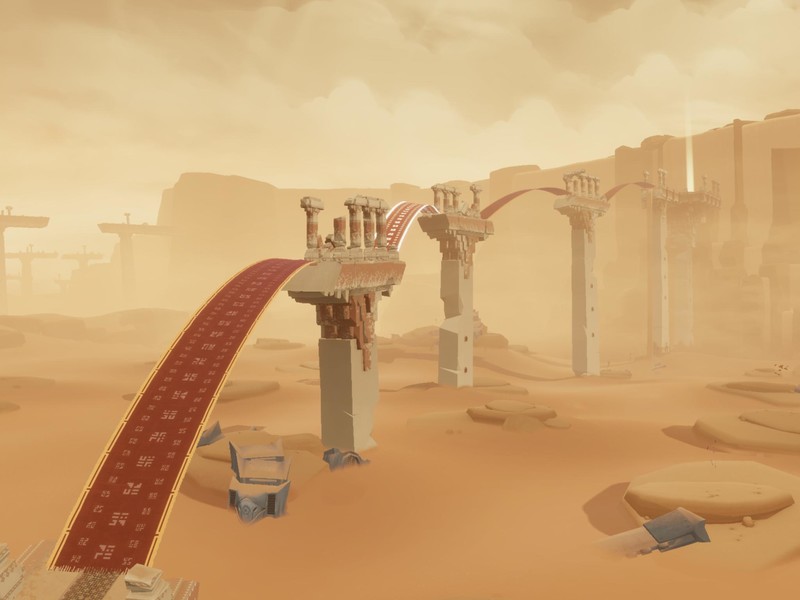
This week I played Journey, which was one of the most beautiful video games I have ever encountered.
The discussion around video game aesthetics is quite tired, most of it pertaining to the author’s bias about whether or not video game graphics can be considered an art form. It is my opinion that they undeniably are, especially when looking at the beautiful animations like those seen in Journey. The article by Simon Niedenthal that we read for class has 3 definitions for game aesthetics:
- The sensory phenomena that the player encounters in the game
- The aspects of digital games that are shared with other art forms
- The game experience as pleasure, emotion, sociability, formgiving, etc.
(Niendenthal 2009)
Personally, I think “aesthetics” can refer to all 3 at the same time. One quote from this article I really liked was, “Where hands, senses, bodies and the tangible qualities of games meet, the aesthetic meaning of games emerges.” (Niendenthal 2009) This definition is especially applicable to Journey because there’s a truly multi-sensational dynamic that all comes together to mold the unique aesthetic of the game.
Speaking of which, let’s talk about Journey. Wow. This game is incredibly beautiful and also incredibly interesting. It manages to mold photorealistic illusionism with caracaturism almost seamlessly. You would think something like this would make the visuals a bit conflicting, but it’s incredibly simple. Actually, the first thing that perplexed me about this game was the minimal controls. I had a unique experience where rather than playing with a controller, I played on an iPad, which just enhanced the minimalistic structure of the game. There is an ability to jump, crouch and move around by moving your finger in the direction you wish to go. The simplicity of this almost complicates it when you realized there aren’t special moves or motives.
That’s the other interesting thing about this game: no rules. I mean of course there are rules and boundaries, but they are completely unwritten. This lack of direction is really efficient in motivating the player to keep going. You don’t know what you’re going towards or why you’re going there, but you want to find out, and that keeps you in the game.
Visually, there is no doubt this game is appealing, but it’s also the unique soundtrack that adds to the gameplay. The sound was mostly non-diegetic but was occasionally dynamic (Collins 2008). I think that the music in this game was mostly used to direct the structure of the game, escalating the drama where dialogue could have. It emphasizes the simplicity of the storyline while somehow increasing the intensity a small amount. The middle-eastern style of the music also matches well with the desert scenery of the game. Overall, complimenting the game in every way.
citations
Niendenthal, Simon. “What We Talk About When We Talk About Game Aesthetics.” Authors & Digital Games Research Association , 2009.
Collins, Karen. “Game Sound.” The MIT Press, 2008.
 alysse writes about games